
Four parts make the basic voice of nearly every synth: the oscillator makes the tone, the filter shapes it, the envelope moves it over time, and the amplifier sets the volume. Learn these four and you can read almost any modular patch.
The oscillator (VCO)
The oscillator makes the raw sound. A voltage controlled oscillator, or VCO, changes pitch when you send it a control voltage. Most VCOs offer a few wave shapes: sine, triangle, sawtooth and square or pulse. A sawtooth sounds bright and buzzy. A square sounds hollow. A sine is smooth and pure.
Every note you play starts here. Two oscillators tuned a little apart give a thick sound, and that is the basis of many classic basses and leads.
The Behringer 921 is a voltage controlled oscillator in the classic style.

Behringer 921 Voltage Controlled Oscillator Eurorack Module
A vintage-style analog oscillator module that fits straight into a Eurorack case and gives you classic 70s tones.
Product information
Product Review Score
4.25 out of 5 stars
(17)Product links
The Erica Synths Pico VCO is a digital oscillator with several wave modes in a small panel.

Erica Synths Pico VCO Digital Multi-Mode Eurorack Oscillator
A compact digital multi-mode oscillator built for Eurorack rigs that need a flexible sound source in a small footprint.
Product information
Product Review Score
4.43 out of 5 stars
(148)Product links
If you prefer a module with many sound types in one panel, the Plaits oscillator by Sound Study Modular is a multi-engine oscillator.

Plaits Eurorack Oscillator Module by Sound Study Modular
A 12HP Eurorack oscillator with sixteen synthesis models split between pitched tones and noise and percussion.
Product information
Product Review Score
4.6 out of 5 stars
(176)Product links
The filter (VCF)
The filter removes part of the sound. A low pass filter cuts the high end, which makes a bright tone darker. When you sweep the cutoff up and down, you hear the classic wah or growl. Resonance boosts the area around the cutoff and gives the filter a sharp edge.
Most of the character of a synth comes from its filter. A good filter makes a simple oscillator sound alive.
The Behringer WASP is a multi-mode filter, so you can switch between low pass, high pass and other modes.

Behringer WASP VCF Eurorack Multi-Mode Filter Module
A Eurorack filter module that brings the classic Wasp Deluxe filter sound into a modular rack.
Product information
Product Review Score
4.2 out of 5 stars
(175)Product links
The Behringer 923 is a dual filter module, with a high pass and a low pass section in one panel.

Behringer 923 Dual Filter Module for Eurorack
A dual filter module with separate lowpass and highpass sections for shaping your sound in Eurorack.
Product information
Product Review Score
4.91 out of 5 stars
(141)Product links
The envelope
An envelope is a control signal that changes over time when you press a key. The most common shape has four stages: attack, decay, sustain and release. Attack is how fast the signal rises. Decay is how fast it falls to the sustain level. Sustain is the level it holds while the key is down. Release is how fast it fades after you let go.
An envelope on the filter makes a note open and close as it plays, which gives pluck, wow and swell. An envelope on the amplifier shapes the volume of each note.
The Behringer 140 is a dual envelope and low frequency oscillator module that you can use for both jobs.
The amplifier (VCA)
A voltage controlled amplifier, or VCA, sets the volume. With no envelope on the VCA, a sound would play all the time. With an envelope, each note starts and stops. Many modules include a VCA in a bigger panel, and some, such as the Behringer 110, combine an oscillator, a filter and an amplifier in one module.

Behringer 110 VCO/VCF/VCA Eurorack Analog Synth Module
A classic analog voice in a single Eurorack module, with its internal wiring already done for you.
Product information
Product Review Score
4.23 out of 5 stars
(151)Product links
That module is a good start because the three parts are already ready to patch.
Extra parts that help
An LFO, or low frequency oscillator, makes a slow wave that you can use as a control signal. It can add vibrato to a pitch or a sweep to a filter. The Behringer Waves has a function generator that does similar work.

Behringer WAVES Tidal Modulator and Function Generator for Eurorack
A two-in-one Eurorack module that handles both modulation and envelope duties from a single panel.
Product information
Product Review Score
4.96 out of 5 stars
(42)Product links
A mixer lets you blend two signals together, and a passive mixer needs no power.

Synthrotek MIX Eurorack Passive Mixer Module
A small passive mixer that blends three signals into one, for audio or control voltage.
Product information
Product Review Score
4.99 out of 5 stars
(188)Product links
A multiple copies one signal to several places so one oscillator can feed two filters.
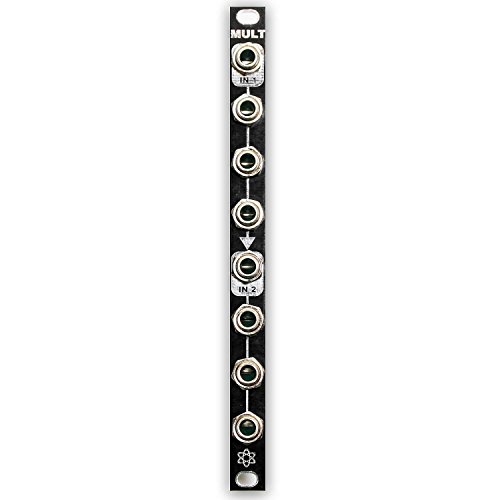
Synthrotek Passive Mult Eurorack Multiple Module
A tiny passive mult that splits one signal into six, with no power needed and only 2HP of panel space.
Product information
Product Review Score
4.54 out of 5 stars
(143)Product links
A crossfader blends smoothly between two signals.

CF Passive Crossfader Eurorack Module
A tiny 2HP passive crossfader that blends two signals without needing any power from your rack.
Product information
Product Review Score
4.34 out of 5 stars
(75)Product links
A compressor evens out loud and quiet parts, such as the 2HP Compressor with a sidechain input.

2HP Compressor Eurorack Module with Sidechain
A tiny 2HP compressor that fits almost any Eurorack case and adds that classic sidechain pumping sound.
Product information
Product Review Score
4.67 out of 5 stars
(191)Product links
How the parts work together
Patch the oscillator to the filter, the filter to the amplifier, and the envelope to the filter and the amplifier. Send a gate from a keyboard or sequencer to start the envelope. Press a key and you get a note that rises, falls and fades.
That chain is called a voice. A bigger system adds a second oscillator, a second envelope, an LFO and a sequencer. The pattern stays the same, so a new module is easier to place once you know the roles.
What each part sounds like on its own
Try each part alone to learn it. Send the oscillator straight to the output and listen to the raw wave. Change the wave shape and hear the change. Then add the filter and sweep the cutoff while a note holds. The sound goes from dull to bright, and with some resonance you hear a clear peak.
Next, add the envelope. Set a short attack and a short decay for a pluck. Set a long attack for a pad that swells. Add the amplifier and use a second envelope on the volume. These small experiments show what each module does, and they cost nothing but a few minutes.
A practical next step
Buy a module for each of the four jobs, patch them in order, and play with the settings for an hour. Change one thing at a time and listen. That habit builds understanding faster than any chart.


