
Start small, buy a case you can grow into, and add one module at a time. That plan keeps a Eurorack system from turning into a drawer of modules you never use. This guide walks through the first steps in order.
What Eurorack is
Eurorack is a standard for modular synthesizer modules. Every module fits a rack of a fixed height, and its width is counted in HP units. Modules take power from a shared supply through a ribbon cable, and you connect them with 3.5 mm patch cables. Because the standard is open, modules from many makers fit in one case.
Step 1: Learn the basics with one box
Before you buy a case, find out what you like. A semi-modular synth teaches the same ideas for a lower cost, because the sound path is already wired. Many players start with a Moog Mother-32 or a Behringer Crave and later move the same ideas into a Eurorack case.

MOOG Mother-32 Semi-Modular Analog Synthesizer
A semi-modular analog synth with a 32-step sequencer that works on your desk or in a Eurorack case.
Product information
Product Review Score
4.38 out of 5 stars
(179)Product links

Behringer CRAVE Analog Semi-Modular Synthesizer
A compact analog semi-modular synth with a ladder filter, pulse and sawtooth oscillator output, and a switchable low or high pass filter.
Product information
Product Review Score
4.18 out of 5 stars
(89)Product links
Step 2: Choose a case and power supply first
A case is the part you keep for years, so choose it with care. Count the HP you think you need and add some room. A common mistake is a case that fits exactly what you own today.
The Arturia RackBrute 3U is a compact case with a power supply built in. It suits a first system.

Arturia RackBrute 3U Eurorack Case with Power Supply
A black 3U rack case that holds 88HP of modules and comes with its own power supply built in.
Product information
Product Review Score
4.09 out of 5 stars
(66)Product links
The Behringer Eurorack Go is a mobile case with two rows of 140 HP. It has enough room for a good-sized system.

Behringer EURORACK GO Mobile 2 x 140 HP Eurorack Case
A rugged, portable 280 HP case that gives your modular rig a home you can carry anywhere.
Product information
Product Review Score
4.94 out of 5 stars
(7)Product links
Power matters as much as the box. Each module draws a little current, and the supply must cover the total. Add the draw of every module, then leave some spare. We cover cases and power in more detail in our case and power guide.
Step 3: Buy the core modules
Most Eurorack systems begin with the same few parts: an oscillator, a filter, an envelope and an amplifier. These make a simple voice. Behringer sells inexpensive versions of classic designs.
The Behringer 921 is a voltage controlled oscillator.

Behringer 921 Voltage Controlled Oscillator Eurorack Module
A vintage-style analog oscillator module that fits straight into a Eurorack case and gives you classic 70s tones.
Product information
Product Review Score
4.25 out of 5 stars
(17)Product links
The Behringer WASP is a multi-mode filter.

Behringer WASP VCF Eurorack Multi-Mode Filter Module
A Eurorack filter module that brings the classic Wasp Deluxe filter sound into a modular rack.
Product information
Product Review Score
4.2 out of 5 stars
(175)Product links
The Behringer 140 is a dual envelope and low frequency oscillator, which gives you shapes to control the filter and the amplifier.
The Behringer 110 combines an oscillator, a filter and an amplifier in one module, which covers the amplifier job.

Behringer 110 VCO/VCF/VCA Eurorack Analog Synth Module
A classic analog voice in a single Eurorack module, with its internal wiring already done for you.
Product information
Product Review Score
4.23 out of 5 stars
(151)Product links
Our guide to the core modules explains what each part does and how they work together.
Step 4: Add control and sound sources
Once you have a voice, add things that make it move. An envelope or low frequency oscillator can control pitch, filter or volume. A sequencer plays notes by itself.
The Behringer Waves module is a tidal modulator and function generator, which gives you slow, shaped movement.

Behringer WAVES Tidal Modulator and Function Generator for Eurorack
A two-in-one Eurorack module that handles both modulation and envelope duties from a single panel.
Product information
Product Review Score
4.96 out of 5 stars
(42)Product links
If you want something that needs fewer other modules, the Erica Synths Pico VCO is a digital oscillator with several wave types.

Erica Synths Pico VCO Digital Multi-Mode Eurorack Oscillator
A compact digital multi-mode oscillator built for Eurorack rigs that need a flexible sound source in a small footprint.
Product information
Product Review Score
4.43 out of 5 stars
(148)Product links
Step 5: Buy utilities that save money
Small utility modules solve many problems. A passive multiple copies one signal to several places. An attenuator turns a signal down. A passive mixer blends signals together. These parts are small and cost little.
The Synthrotek Passive Mult Eurorack Multiple is an example.
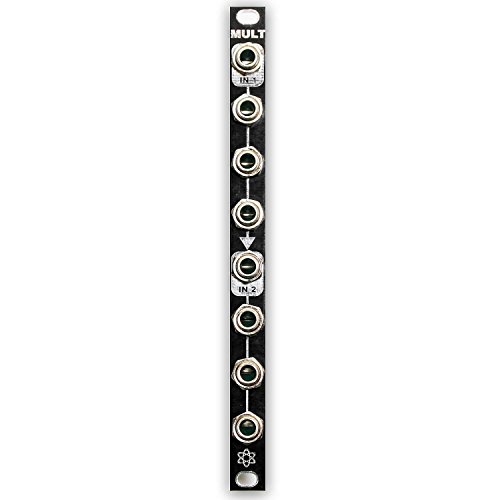
Synthrotek Passive Mult Eurorack Multiple Module
A tiny passive mult that splits one signal into six, with no power needed and only 2HP of panel space.
Product information
Product Review Score
4.54 out of 5 stars
(143)Product links
The Synthrotek MIX is a passive mixer module.

Synthrotek MIX Eurorack Passive Mixer Module
A small passive mixer that blends three signals into one, for audio or control voltage.
Product information
Product Review Score
4.99 out of 5 stars
(188)Product links
Step 6: Buy cables
You will need patch cables early. A pack of mixed lengths covers most cases. Short cables keep a small system tidy. We cover lengths and types in our patch cable guide.
Common first mistakes
New buyers often start with a large number of small modules and no plan. The result is a case full of parts that do not make a voice. Begin with one oscillator, one filter, one envelope and one amplifier, and make sure you can play a note from them before you buy a fifth module.
Another mistake is to buy modules by name. A module that is famous may not suit your system. Read the manual, check the size and the power draw, and watch a demo that shows the module with other gear. Most makers publish a manual online, and it tells you what the module needs before you spend money.
Finally, give yourself time. A modular system rewards patience, and the sound you want often comes from a simple patch used well.
Rules that save money
- Buy one module at a time. Use it for a few weeks before the next.
- Check the module depth. Some modules are deep and will not fit a shallow case.
- Check the power draw before you buy, and keep a margin.
- Watch the ribbon cable. The red stripe marks the negative twelve volt line, and it must line up with the marked pin on the module and the power board.
Take your time. A system that grows slowly is easier to understand than one bought in a week.


