
Reverb and delay add space to a synth. A dry synth sounds close and flat. A little reverb makes it sit in a room, and a delay repeats notes to make rhythm and depth. A pedal is the cheapest way to add either one, and most pedals work with a synth as well as a guitar.
Why pedals work with synths
A pedal accepts an audio signal and returns it with an effect added. It does not care where the signal comes from. A synth with a 1/4 inch output can connect to a pedal with a normal instrument cable. Many synths and modules also have a line level output, which is hotter than a guitar signal, so choose a pedal that handles it. Check the manual if the sound distorts.
Most pedals are mono in and mono out. A few have stereo outputs. If your synth is stereo and you want to keep the image, look for a stereo pedal.
Reverb pedals
Reverb adds the sound of a space. Short settings sound like a small room, and long settings sound like a hall.
The BOSS RV-6 is a digital reverb with several modes.

BOSS RV-6 Digital Reverb Guitar Pedal
A compact digital reverb pedal with eight sound modes, simple controls and stereo or mono operation for guitar.
Product information
Product Review Score
4.44 out of 5 stars
(116)Product links
The Behringer DR600 is a digital stereo reverb pedal at a low price.

Behringer DR600 Digital Stereo Reverb Effects Pedal
A stereo digital reverb pedal with stereo inputs and outputs for running a full-width sound through your rig.
Product information
Product Review Score
4.22 out of 5 stars
(28)Product links
The JOYO R-14 Atmosphere is a reverb with nine modes.

JOYO R-14 Atmosphere Reverb Guitar Pedal with 9 Modes
A compact mono reverb pedal with nine selectable modes, trails and ambient LEDs for guitar boards.
Product information
Product Review Score
4.77 out of 5 stars
(41)Product links
The JHS Pedals 3 Series Reverb is a simple reverb in a small box.

JHS Pedals 3 Series Reverb Guitar Pedal
A versatile reverb pedal built in Kansas City that handles everything from tight room sounds to huge ambient washes.
Product information
Product Review Score
4.12 out of 5 stars
(179)Product links
The FLAMMA FC02 is a mini reverb with studio, church and plate settings.

FLAMMA FC02 Mini Reverb Pedal with Studio, Church and Plate
A small metal reverb pedal with three room styles and a true bypass for guitar and bass setups.
Product information
Product Review Score
4.87 out of 5 stars
(225)Product links
The M-VAVE Mini Universe Pro has nine digital effects, and M-VAVE is a brand that also makes MIDI controllers for synth players.

M-VAVE Mini Universe Pro Guitar Reverb Pedal with 9 Digital Effects
A small metal reverb pedal with nine digital tones, built for guitar and bass players who want space without a big board.
Product information
Product Review Score
4.36 out of 5 stars
(25)Product links
Delay pedals
A delay repeats the sound after a short time. A short delay gives a slap, and a long delay gives echoes. Feedback sets how many repeats you hear. Repeats from an analog delay get darker each time, which suits synth lines.
The BOSS DD-8 is a digital delay with several modes.
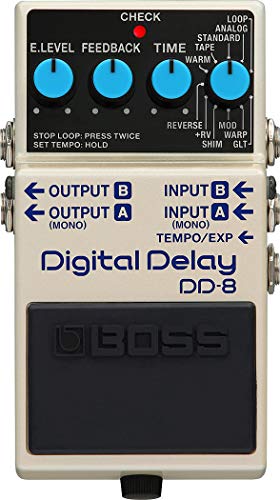
BOSS DD-8 Digital Delay Guitar Effects Pedal
A compact delay pedal with eleven modes, a built-in looper and up to 10 seconds of delay time.
Product information
Product Review Score
4.66 out of 5 stars
(149)Product links
The Behringer VD400 is a vintage analog delay, with warm repeats.

Behringer VD400 Vintage Analog Delay Pedal, White
A white analog delay pedal with BBD circuitry for warm, vintage-style echoes on guitar, bass or synth.
Product information
Product Review Score
4.68 out of 5 stars
(209)Product links
The Donner White Tape is a stereo delay with analog echo.

Donner White Tape Stereo Delay Pedal with Analog Echo
A stereo tape delay pedal with two independent channels, built to add warm echo to guitars, synths and drum machines.
Product information
Product Review Score
4.97 out of 5 stars
(173)Product links
Reverb and delay in one
A 2 in 1 pedal saves space and cost.
The Donner Revecho gives you reverb and delay in one pedal.

Donner Revecho 2-in-1 Reverb and Delay Guitar Pedal
A compact guitar pedal that pairs delay and reverb in one box, with tap tempo for syncing to your playing.
Product information
Product Review Score
4.49 out of 5 stars
(226)Product links
The SONICAKE Sonic Ambience also combines delay and reverb.

SONICAKE Sonic Ambience Delay Reverb Pedal for Guitar and Bass
A compact stompbox that stacks four delay modes and four reverb modes into one small enclosure for guitar or bass.
Product information
Product Review Score
4.89 out of 5 stars
(51)Product links
The MOOER Meta FX adds reverb, delay and modulation in a small stompbox.

MOOER Meta FX Stompbox Reverb Delay Modulation
A floor-format multi-effects stompbox with swappable reverb, delay and modulation firmware, a color touchscreen and stereo I/O.
Product information
Product Review Score
4.8 out of 5 stars
(133)Product links
How to connect
Plug the synth output into the pedal input, and connect the pedal output to your mixer, audio interface or amp. If you use more than one pedal, put delay first and reverb last. That order lets the reverb blur the repeats and sounds natural. Try the reverse for a different feel.
If your synth has stereo outputs, use two pedals or choose a stereo model.
Tips for synth sounds
- Keep the mix low. A little reverb is enough, and too much washes out the notes.
- Use short delay for rhythm and long delay for ambience.
- On bass sounds, turn the effect down, or the low end gets muddy.
- On pads, a longer reverb gives a soft, wide sound.
Power and noise
Most pedals run on a nine volt supply. Use the adapter that fits the pedal, and check the polarity and voltage on the pedal's label before you plug it in. Pedals that share a daisy chain adapter can add hum, so use an isolated supply if you hear noise. A synth already has a low noise floor, so a pedal with a noisy supply stands out.
If you hear hum, try a shorter cable, move the pedal away from the power adapter and try a different outlet. Most noise problems come down to one of these three things.
Placing a pedal in a bigger setup
If you run a mixer, you can use an effects send and return instead of a pedal in line. A send takes a copy of the sound to the effect and the return brings back only the effect, so you can balance the dry and wet signals on the mixer. That suits a reverb shared by several synths. A pedal in line suits a single synth when you want the effect on that sound only.
Whichever you choose, set the pedal level first. A pedal that is too quiet adds noise when you turn up the mixer, and one that is too loud may clip. Match the pedal output to the level you had before it, then adjust the mix to taste.
Where to start
Choose one reverb and one delay, or one combined pedal. Learn their controls on a simple patch before you add more. Start with the mix, then the time or decay, then the feedback. A small pedal board is cheap, quick to set up and changes the character of every synth you own.


